
Purpose: To determine relationships between post-exercise changes in systemic [testosterone, growth hormone (GH), insulin like grow factor 1 (IGF-1) and interleukin 6 (IL-6)], or intramuscular [skeletal muscle androgen receptor (AR) protein content and p70S6K phosphorylation status] factors in a moderately-sized cohort of young men exhibiting divergent resistance training-mediated muscle hypertrophy.
Methods: Twenty three adult males completed 4 sessions•wk-1 of resistance training for 16 wk. Muscle biopsies were obtained before and after the training period and acutely 1 and 5 h after the first training session. Serum hormones and cytokines were measured immediately, 15, 30 and 60 minutes following the first and last training sessions of the study.
Results: Mean fiber area increased by 20% (range: -7 to 80%; P<0.001). Protein content of the AR was unchanged with training (fold change = 1.17 ± 0.61; P=0.19); however, there was a significant correlation between the changes in AR content and fiber area (r=0.60, P=0.023). Phosphorylation of p70S6K was elevated 5 hours following exercise, which was correlated with gains in mean fiber area (r=0.54, P=0.007). There was no relationship between the magnitude of the pre- or post-training exercise-induced changes in free testosterone, GH, or IGF-1 concentration and muscle fiber hypertrophy; however, the magnitude of the post exercise IL-6 response was correlated with muscle hypertrophy (r=0.48, P=0.019).
Conclusion: Post-exercise increases in circulating hormones are not related to hypertrophy following training. Exercise-induced changes in IL-6 correlated with hypertrophy, but the mechanism for the role of IL-6 in hypertrophy is not known. Acute increases, in p70S6K phosphorylation and changes in muscle AR protein content correlated with muscle hypertrophy implicating intramuscular rather than systemic processes in mediating hypertrophy.
Revista de Entrenamiento Deportivo
Configuración de las Series en el Ejercicio de Fuerza: Fatiga Muscular y Efectos Cardiovasculares
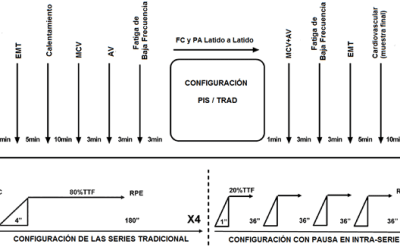
Purpose: Cardiovascular responses of traditional resistance (TS) training have been extensively explored. However, the fatigue mechanisms associated with an intra-set rest configuration (ISR) have not been investigated. This study compares two modalities of set configurations for resistance exercise that equates work to rest ratios and measures the central and peripheral fatigue in combination with cortical, hemodynamic and cardiovascular measures. Methods: 11 subjects performed two isometric knee extension training sessions using TS and ISR configurations. Voluntary activation (VA), single twitch amplitude, low frequency fatigue (LFF), Mwave, motor evoked potential (MEP), short intracortical inhibition (SICI), intracortical facilitation (ICF) and heart rate variability were evaluated before and after each training session. During each session beat to beat heart rate, blood pressure and rate pressure product (RPP) were also evaluated. Results: After exercise VA decreased significantly for TS but not for ISR (P < 0.001), single twitch amplitude and LFF values were lower for TS than ISR (P < 0.004), and SICI was reduced only for the TS configuration (P = 0.049). During exercise RPP values were significantly higher for the TS than for ISR (P = 0.001). RPP correlated with VA for TS (r = -.85 P < 0.001) suggesting a relationship between central fatigue and cardiovascular stress. Conclusions: We conclude that ISR induced lower central and peripheral fatigue as well as lower cardiovascular stress in comparison with TS configuration. Our study suggests that set configuration is a key factor in the regulation of the neuromuscular and cardiovascular responses of resistance training.
Consistencia en los Patrones de Aceleración de Jugadores de Fútbol con Diferentes Niveles de Habilidad
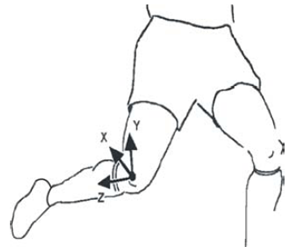
Los objetivos del presente estudio fueron comparar la consistencia en los patrones de aceleración de la extremidad inferior durante golpeos de balón realizados con la parte interna del pie y con el empeine en jugadores con diferentes niveles de habilidad, e investigar la correlación entre los resultados de valores subjetivos para el nivel de habilidad en relación con su rendimiento en la patada y la repetibilidad de la aceleración de la rodilla. Trece hombres jugadores de fútbol de nivel local de entre 15-16 años participaron de este estudio. El nivel de habilidad de cada jugador se cuantificó con anterioridad evaluando el rendimiento durante golpeos de pie y asignando a esto un valor numérico en el rango de 1 a 10. Las evaluaciones adicionales se llevaron a cabo recolectando los datos de aceleración tri-axial registrados en la tuberosidad tibial próxima debajo de cada rótula de los jugadores, en un procedimiento en el que se les pidió a los jugadores que completaran cuatro intentos de lanzamiento en orden aleatorio con golpeos del balón realizados con la parte interna del pie y con el empeine, y con intervalos de recuperación de 2 minutos. De esta manera, los datos utilizados en los cálculos de consistencia estuvieron en la forma matrices de 4 por 1200 matrices (aceleración vs tiempo) por sujeto. A fin de evaluar la consistencia de los datos de la aceleración, se calculó la media de las desviaciones estándar (mDE), y se incorporaron los coeficientes de correlación de Pearson r para obtener las correlaciones de la mDE en relación con la habilidad. Como resultado, se halló que la repetibilidad aumenta con el nivel de habilidad en la aceleración del eje z sólo para los golpeos del balón realizados con el empeine. Sin embargo, es posible hallar la orientación más apropiada (para los dos tipos de golpeos) para obtener correlaciones significativas utilizando rotaciones del vector con los datos de la aceleración en los 3 ejes ortogonales, y este estudio muestra que, luego de dichas rotaciones adecuadas del vector, también se podrían obtener resultados positivos de repetibilidad para los golpeos realizados con la parte interior del pie.
PROXIMAS FORMACIONES
No se encontraron resultados
La página solicitada no pudo encontrarse. Trate de perfeccionar su búsqueda o utilice la navegación para localizar la entrada.